Patient-centric data design: what my master's thesis on a wearable recovery system found
A smartwatch, phone, and monitor system for heart patients for post-PCI recovery | From hospital bed to home: a patient-centric self-care design for life after a heart procedure
Summary of my Karolinska Institutet thesis: a multi-device self-care system for heart patients recovering at home, and what eight experts made of it.
The problem
Coronary artery disease is the most common form of heart disease, with a global prevalence of roughly 5–8% (1). A common treatment is percutaneous coronary intervention (PCI), a minimally invasive procedure that reopens a narrowed artery, usually with a balloon and a stent. Compared with bypass surgery, it is typically less risky, and recovery is shorter (2).
That speed has a downside. Most patients go home the day after, with instructions on wound care, medication, activity, diet, and rehabilitation, and are then largely on their own. The research I reviewed kept pointing to the same gaps: low continuity of self-care, anxiety and uncertainty after a short discharge with little follow-up guidance (3), and poor medication adherence when patients don't fully understand their condition or their drugs (4). These gaps can lead to readmissions and higher costs.
Smartwatches already track heart rate, activity, and sleep, but existing self-management apps often have interfaces that are hard for older people, struggle to connect several devices, aren't linked to the electronic health record (EHR), and can't send personalised reminders. And I found a lack of studies on smartwatch apps connected to the EHR specifically for self-care after PCI.
What I set out to do
In my master's thesis in Health Informatics at Karolinska Institutet (5), I set out to create a conceptual design for a patient-centric, multi-device system that helps people recovering from PCI manage their own care through an intuitive, data-driven interface. The work was done in collaboration with Samsung, so the design builds on Samsung's devices and Samsung Health.
How I did it
I followed Design Science Research, an iterative method for building and evaluating a designed artefact:
- Problem and objectives: a literature review to define the key needs and features for post-PCI care.
- Design: a data flow diagram, wireframes for each screen, then a full user interface in Adobe XD.
- Demonstration: a persona, a 58-year-old sales manager in Stockholm recovering from PCI, and a scenario of his day on each device, using mock data only.
- Evaluation: an expert review with eight experts from Sweden and China: two cardiologists, a health tech expert, two Samsung product managers, a software developer, a business manager, and a UX designer. They answered yes/no and open questions and rated each platform from 1 to 5, and I analysed the answers with thematic analysis.
What I designed
The system, Recovery+, brings data into one cloud secured by Samsung Knox: from the smartwatch (activity, heart rate, sleep, medication logs), external devices such as blood pressure monitors and, where legally possible, the EHR (prescriptions and appointments).
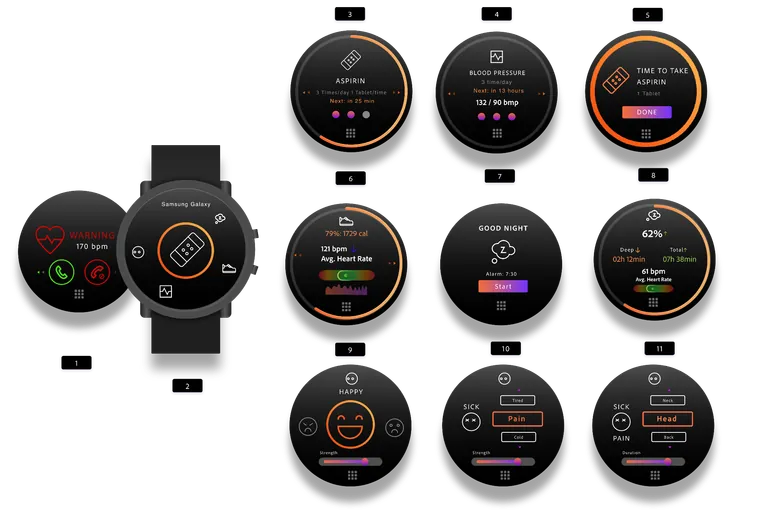
- Smartwatch: alerts for abnormal heart rate, medication reminders you can tick off, exercise and sleep progress, and a mood and pain log.
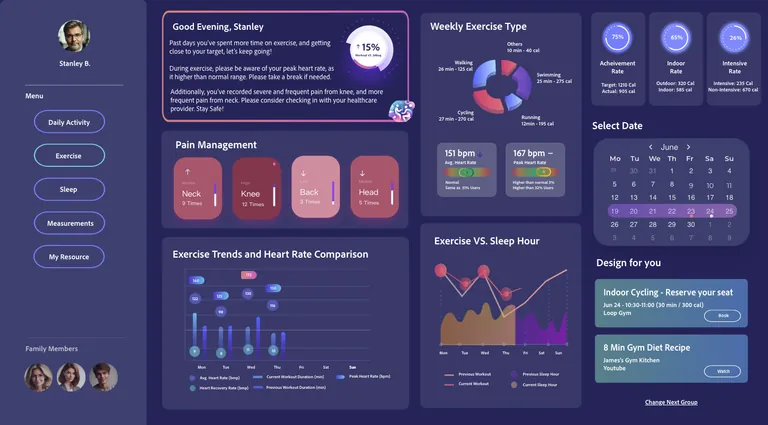
- Monitor (laptop, tablet or TV): a dashboard with a recovery timeline, daily and weekly overviews, views that flag abnormal values, and a page for booking appointments and tailored health education.
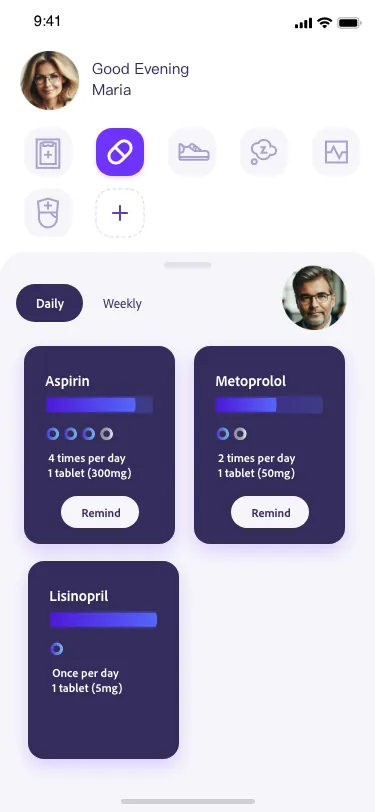
- Phone: the same data in a compact layout, plus family access, so relatives can follow progress and send reminders.
What the experts found
The core idea held up. All eight experts said the features were relevant and the prototype met its purpose. The most-praised strengths were comprehensive summaries (7 of 8), real-time tracking (7), multi-device connection (7), warnings and reminders (6) and clear graphs (6). The average overall rating was 4.5 out of 5.
Usability was a different story. Only three of the eight said the interfaces had good usability. The main concern was content overload in the default setting for older and younger users, and six experts said the screens would be hard to read for seniors. Others flagged unclear icons, values that needed explaining and no help for usage questions. The monitor scored lowest on design. Answers on technical points such as data security and EHR integration were mixed.
The experts also asked for an AI chatbot, preset answers to common questions and a mood tracker, and seven recommended consulting specialists on data compliance. Diet tracking and risk prediction were added as future options after the review.
Limitations
- No patients were interviewed, so end users' own experience is missing.
- Eight experts from very different backgrounds is a small, mixed sample.
- The experts saw static images, not a working system, so a standard usability questionnaire couldn't be used and speed or data sharing couldn't be tested.
- No legal experts were consulted, so the data-related functions rest on assumptions, and whether EHR data may flow into Samsung Health wasn't explored.
What comes next
The thesis points to four directions:
- AI support: answering users' questions, explaining health figures in plain language and predicting complications.
- Design for different users: larger text for seniors, more customisation, multilingual support and accessibility.
- Secure data integration: built with legal and data specialists, and transparent about what is collected.
- Real user research: patient interviews and A/B tests of icons and visuals.
References
- Bauersachs, R., Zeymer, U., Brière, J.-B., Marre, C., Bowrin, K., & Huelsebeck, M. (2019). Burden of coronary artery disease and peripheral artery disease: A literature review. Cardiovascular Therapeutics, 2019, Article 8295054. https://doi.org/10.1155/2019/8295054
- Ahmad, Y. (2022). Percutaneous coronary intervention (PCI). Yale Medicine. https://www.yalemedicine.org/conditions/percutaneous-coronary-intervention-pci
- Zhang, T., & Qi, X. (2021). Greater nursing role for enhanced post-percutaneous coronary intervention management. International Journal of General Medicine, 14, 7115–7120. https://doi.org/10.2147/IJGM.S337385
- Pettersen, T. R., Fridlund, B., Bendz, B., Nordrehaug, J. E., Rotevatn, S., Schjøtt, J., & Norekvål, T. M. (2018). Challenges adhering to a medication regimen following first-time percutaneous coronary intervention: A patient perspective. International Journal of Nursing Studies, 88, 16–24. https://doi.org/10.1016/j.ijnurstu.2018.07.013
- Wang, X. (2024). Multi-devices self-management for post-PCI patients: A conceptual system design [Master's thesis, Karolinska Institutet].